Have you ever taken a class to a museum and watched their attention dissolve somewhere between the display cases after twenty minutes? An escape room works the other way round. Nobody drifts off, because from the first minute everyone has something to do and the clock is ticking for all of them equally. Below we explain what students actually learn in that hour, what the national core curriculum has to say about it, and how to fund the visit through a city programme.
From escaping to learning
The first escape room opened in Japan in 2007. The trend reached Poland six years later: in November 2013 the country’s first venue opened in Wrocław. Over the following decade, not only the size of the market changed, but the point of the whole thing.
At the beginning it was exactly what the original name suggested. You had to solve puzzles in order to get out of a locked room, and the rush of adrenaline was the entire appeal. Today the emphasis has shifted towards education. The winner is no longer the person who got out, but the one who learned something and proved themselves in a team. Polish usage shifted along with it, from “escape room” towards pokój zagadek, literally a puzzle room. Teaching literature now has a separate term for the format built around teaching goals from the ground up: the educational escape room.
What researchers say
Sara Burchert of the University of Warsaw, in an article published in Studia Politologiczne on the escape room model as an innovative teaching tool in the social sciences, points to several theoretical foundations for the format. These include game-based learning, situated learning, the zone of proximal development, and self-determination theory. She also highlights the multimodal nature of the experience, team learning, and experiential learning.
Put more simply: the brain retains what it lived through alongside other people, under time pressure, far better than what it read in a textbook. The escape room has stopped being an escape from a locked room and become an escape from routine ways of passing on knowledge.
The format has also made its way into higher education. The Centre for Teaching Excellence and Tutoring at the University of Gdańsk runs a workshop for lecturers and doctoral students on designing educational escape rooms for university classes. If universities are reaching for it, it is hard to treat it purely as weekend entertainment.
The core curriculum says so directly
Nothing here needs stretching. It is enough to open the national core curriculum for upper secondary schools. Among its stated aims of general education are:
- refining thinking and language skills such as reading comprehension, formulating questions and problems, applying criteria, justifying, explaining, classifying and drawing conclusions;
- developing students’ personal interests and integrating subject knowledge across different disciplines;
- learning to form independent, considered judgements and to justify both their own and other people’s judgements;
- combining critical and logical thinking with imaginative and creative abilities.
It would be hard to find a better description of what goes on in students’ heads during ninety minutes of play.
And all of it inside an escape room
The core curriculum goes further and lists the most important skills to be developed at upper secondary level. A well-designed team game can support many of them at once:
- thinking — a complex mental process of creating new representations by transforming available information, covering inference, abstraction, reasoning, imagination, judgement, problem solving and creativity;
- reading — the ability to grasp both the meaning and the symbolic significance of a message;
- creative problem solving across different fields, with deliberate use of methods and tools derived from computer science;
- confident use of modern information and communication technologies;
- finding information independently, then selecting, synthesising and evaluating it, and using sources responsibly;
- working within a group while remaining capable of acting individually.
An escape room will not replace a lesson, and that is not its job. What it adds to classroom methodology is something difficult to achieve at a whiteboard: a genuine problem situation in which knowledge immediately has a use.
There is one more, purely practical advantage. None of it reminds students of school, so it goes down more easily. Knowledge picked up among friends, disguised as an adventure, does not carry the label of an obligation.
How it works at our venue
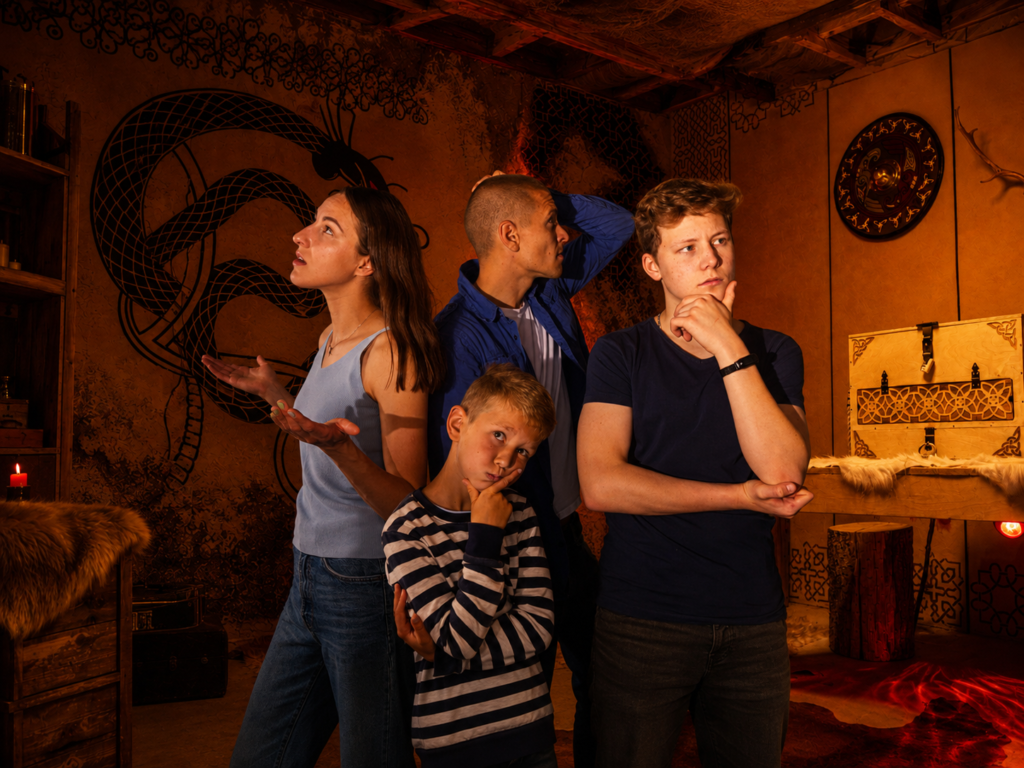
At Kreatywny Świat we see this every day, as school groups make up a growing share of our bookings. Younger children usually go for “Magiczny: Polska Szkoła Magii” (The Magical Room: The Polish School of Magic), where the team spends 101 minutes passing one magical exam after another, and for “Twoja Bajka” (Your Fairy Tale). Both work equally well for class trips and family visits, since parents tend to enjoy themselves no less than their children.
Older students head towards “Wikingowie: Widmo Ragnaröku” (The Vikings: The Spectre of Ragnarök) or “Piraci: Złoto Karaibów” (The Pirates: Caribbean Gold). That is where things surface that no test will ever measure. Who listens, who takes the initiative, who divides up tasks under time pressure, and who is first to notice the team heading the wrong way. Teachers often tell us afterwards that they saw their class in an entirely new arrangement.
A few practical details for planning a visit:
- Magiczny: Polska Szkoła Magii — 101 minutes, 2 to 8 players, fantasy setting, the usual choice for younger classes;
- Wikingowie: Widmo Ragnaröku — 80 minutes, 2 to 6 players, an adventure scenario drawn from Norse mythology;
- Piraci: Złoto Karaibów — 80 minutes, 2 to 6 players, a hunt for treasure through a series of traps.
For a full class we split the group and run teams through several rooms in parallel, then swap them over.
Funding a class trip through the city
Since 2019 Warsaw has run a programme called “Klasa w Warszawie. Warszawa z klasą”, which provides schools with funds for students to take part in cultural, academic and sporting events outside school. The Mayor of Warsaw confirmed that the project would continue in 2026. The scale is considerable: in 2025 more than 230,000 children and young people took part, and over 95 per cent of schools rated it as genuine teaching support.
Two points worth knowing. The programme covers schools for which the City of Warsaw is the governing body, so independent and international schools are not eligible. And the head teacher decides how the money is spent, in consultation with the teaching council, the parents’ council and form tutors. Both are good reasons to plan a trip well in advance.
Book a slot for your class
If you are planning a visit under the “Klasa w Warszawie. Warszawa z klasą” programme, please mention it when you book. We have a dedicated offer for school groups and participants in educational programmes, in Warsaw and beyond. Write or call us and we will help match the room to your students’ age and class size, and arrange the schedule so the whole group plays on the same day.
The escape room has travelled from a game about getting out of a locked room to a tool that schools and universities now reach for. It builds teamwork, reading comprehension and logical thinking, precisely the skills the national core curriculum lists. It does so, however, in a form students never register as a lesson. In Warsaw, such a trip can also be funded through a city programme.
How did it go for you? If you have already been to an escape room with a class or with your own child, tell us in the comments what surprised you most. We would like to hear what you noticed.